
Che cosa sono gli NFT? Hanno aperto una mostra appena dedicata presso Palazzo Strozzi a Firenze fino al 31 luglio, cercherò di darvi una prospettiva chiara.
NFT = Non Fungible Token cioè qualcosa di NON materiale e NON Fungibile. E’ una cosa virtuale, digitale, immateriale, di cui potete fruire solo nel Metaverso se ne siete parte. Ma, nel campo dell’arte, che non potete appendervi alla parete!
E’ un titolo di proprietà, un certificato sicurissimo che garantisce la proprietà, l’utilizzo di un bene virtuale associato ad un artista. Non è duplicabile interamente e funziona come le criptovalute basate su blockchain. Nessuna persona fisica può controllare gli scambi, questi sono controllati da algoritmi eseguiti da tutti i computer che partecipano alla blockchain.
La prima opera NFT Quantum è del 2014.
Il processo di creazione o “minting“, che può costare da meno di un dollaro in su, è l’atto di pubblicazione di un certifica NFT su blockchain.
Blockchain è un registro pubblico di dati che documenta scambi di proprietà di oggetti digitali tra diversi soggetti, caratterizzato da blocchi concatenati in ordine cronologico. E’ una tecnologia introdotta nel 2008 come struttura base della criptovaluta o Bitcoin. La blockchain più diffusa è Ethereum.
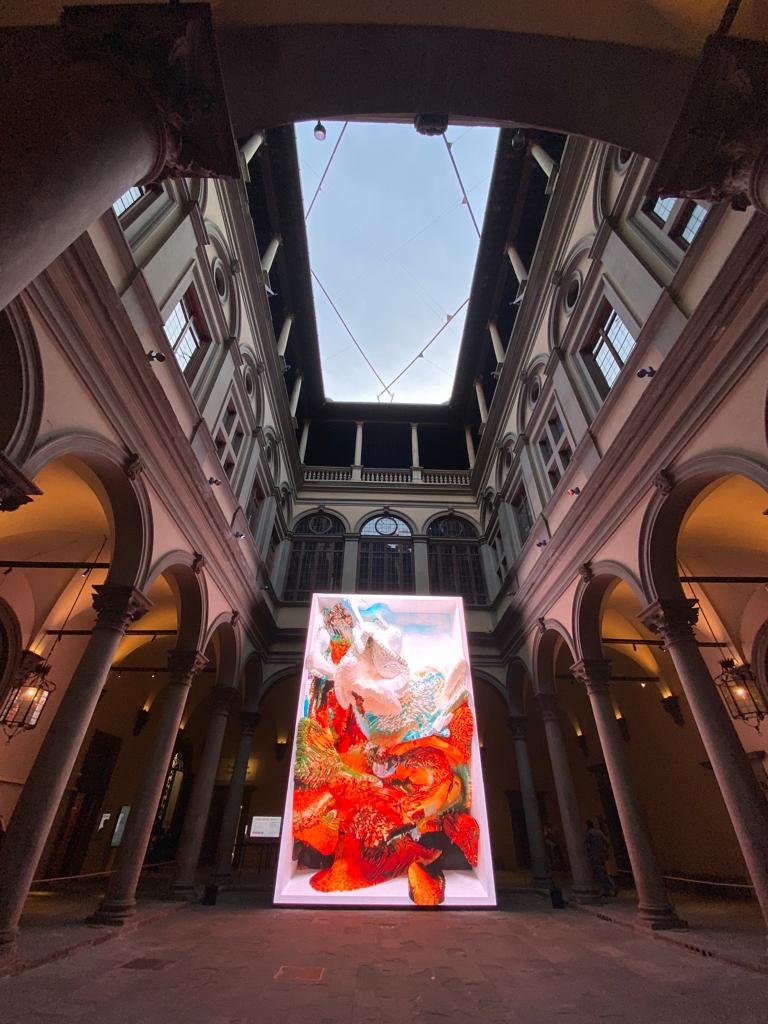
Cortile di Palazzo Strozzi
Opera o riproduzione?
Allora farne una mostra ha senso? Se non è riproducibile, non deve essere fungibile, cosa stiamo guardando? Una riproduzione, un video o l’opera vera e propria?
Walter Benjamin (1982-1940) nel suo saggio “L’opera d’arte nell’epoca della sua riproducibilità tecnica” del 1936 è stato il primo a teorizzare che ogni opera abbia un’Aura non riproducibile.
Benjamin sottolinea che l’opera d’arte è sempre stata riproducibile e riprodotta attraverso tecniche grafiche, ma queste forme di riproduzione erano comunque procedimenti artigianali. La stampa è stato il primo procedimento di riproduzione meccanico, che ha trasformato profondamente la produzione scritta e le sue forme di fruizione.
La riproduzione tecnicamente perfetta della fotografia o del cinema modifica lo statuto stesso dell’opera d’arte. Nel passato la relazione tra l’arte e lo spettatore era definito dall’unicità ed irripetibilità dell’opera d’arte. Fa parte di questa unicità anche la tradizione con le sue modificazioni materiali ed i passaggi di proprietà. Questa dimensione genetica e temporale dell’esistenza artistica si condensa nella sua ‘autenticità’, rispetto alla quale ogni forma di riproduzione manuale risulta falsa.
La riproduzione ripete l’opera d’arte sottraendole l’autenticità, che ne costituiva nel passato la caratteristica fondamentale. L’arte perde in questo modo la sua caratteristica tradizionale, l’aura. Secondo Benjamin, tecniche quali il cinema, la fotografia invalidano la concezione tradizionale di “autenticità” dell’opera d’arte. Infatti, tali nuove tecniche permettono un tipo di fruizione nella quale perde di senso il distinguere tra fruizione dell’originale e fruizione di una copia.
Può essere un investimento?
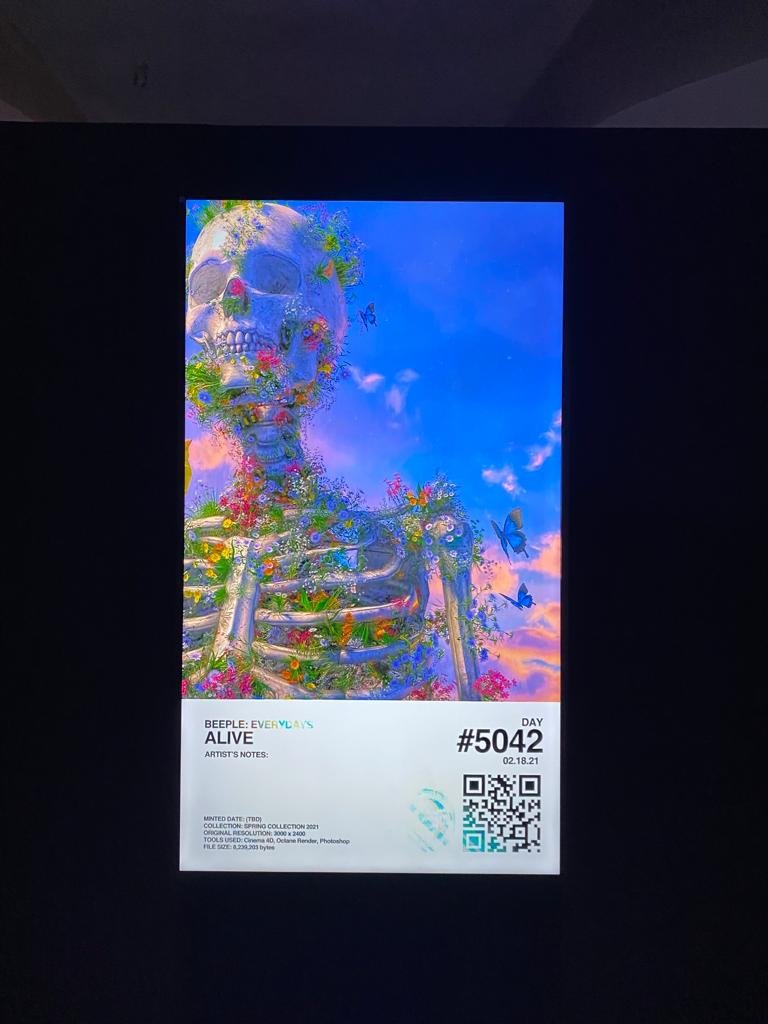
L’operazione più rilevante fino a oggi rimane quella effettuata da Mike Winkelmann, conosciuto con il nome d’artista Beeple, con la sua opera digitale “Everyday – The first 5000 days” venduta per la cifra di 70 milioni di dollari.
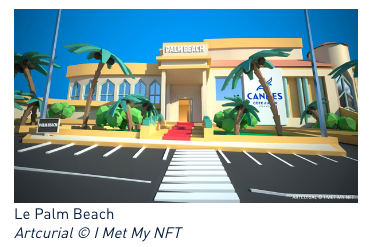
Troverete aste in tutte le maggiori case d’asta dedicate appositamente agli NFT come Parallel Universe di Christie’s il 26 maggio o Artcurial che venderà dieci edifici simbolo di Cannes come NFT il 21 giugno. Pandolfini ha creato il dipartimento apposta Digital Art e NFT.
Una ricerca del magazine Hyperallergic rivela che il mercato NFT riproduce la dinamica del mercato dell’arte in cui il 10% dei collezionisti è responsabile delle stesse transazioni effettuate dal rimanente 90% e che la spesa media per un NFT è di 15USD. Un largo numero di artisti vende NFT online, ma solo una piccolissima parte vende realmente.
Al momento è un grande trend, ma tutti ci chiediamo se durerà. I grandi artisti come Jeff Koons arrancano per creare loro opere NFT andando sulla Luna, ma sono arrivati DOPO. Damien Hirst dà l’opportunità di scegliere tra edizione stampata o NFT da redimere e stampare successivamente. Perché comunque le persone preferiscono avere qualcosa di fungibile da vedere.
Infatti Palazzo Strozzi con la sua mostra Let’s get digital ne è la prova. Come si può proiettare il video di un NFT che non può, non deve essere fungibile? E’ una riproduzione e non è l’opera vera e propria. allora perché fare la mostra fisica? Sarebbe meglio fare una mostra nel metaverso virtuale, come tante case di moda stanno cominciando ad organizzare le sfilate. E si può acquistare un capo NFT da far indossare al proprio avatar o un edificio in cui farlo “vivere”.
ENG TXT
What are NFTs? It has been opened a newly dedicated exhibition at Palazzo Strozzi in Florence until July 31, I will try to give you a clear perspective.
NFT = Non Fungible Token that is something NOT material and NON Fungible. It is a virtual, digital, immaterial thing that you can only enjoy in the Metaverse if you are a part of it. But, in the field of art, you can’t hang on the wall!
It is a property title, a very secure certificate that guarantees the ownership, the use of a virtual asset associated with an artist. It is not fully duplicable and works like blockchain-based cryptocurrencies. No natural person can control the exchanges, these are controlled by algorithms executed by all the computers participating in the blockchain.
The first NFT Quantum work is from 2014.
The creation or “minting” process, which can cost anything from under a dollar upwards, is the act of publishing an NFT certificate on the blockchain.
Blockchain is a public register of data that documents ownership exchanges of digital objects between different subjects, characterized by blocks concatenated in chronological order. It is a technology introduced in 2008 as the basic structure of the cryptocurrency or Bitcoin. The most popular blockchain is Ethereum.
Work of art or reproduction?
So does making an exhibition of it make sense? If it’s not reproducible, it doesn’t have to be fungible, what are we looking at? A reproduction, a video or the actual work?
Walter Benjamin (1982-1940) in his essay “The work of art in the age of its technical reproducibility” of 1936 was the first to theorize that every work has an unreproducible aura.
Benjamin points out that the work of art has always been reproducible and reproduced through graphic techniques, but these forms of reproduction were nevertheless artisanal procedures. Printing was the first mechanical reproduction procedure, which profoundly transformed written production and its forms of fruition.
The technically perfect reproduction of photography or cinema changes the very status of the work of art. In the past, the relationship between art and the viewer was defined by the uniqueness and unrepeatability of the work of art. Tradition is also part of this uniqueness with its material modifications and changes in ownership. This genetic and temporal dimension of artistic existence is condensed in its ‘authenticity’, with respect to which any form of manual reproduction is false.
Reproduction repeats the work of art, subtracting its authenticity, which was its fundamental characteristic in the past. In this way, art loses its traditional characteristic, the aura. According to Benjamin, techniques such as cinema, photography invalidate the traditional conception of “authenticity” of the work of art. In fact, these new techniques allow a type of use in which the distinction between use of the original and use of a copy loses meaning.
Could it be an investment?
The most significant operation to date remains that carried out by Mike Winkelmann, known by the artist name Beeple, with his digital work “Everyday-The first 5000 days” sold for 70 million dollars.
You will find auctions in all the major auction houses dedicated specifically to NFTs such as Christie’s Parallel Universe on May 26 or Artcurial which will sell ten iconic buildings of Cannes as NFT on June 21.
Research by Hyperallergic magazine reveals that the NFT market reproduces the dynamics of the art market in which 10% of collectors are responsible for the same transactions made by the remaining 90% and that the average spend for an NFT is 15USD. A large number of artists sell NFTs online, but only a very small fraction actually sells.
It’s a big trend right now, but we’re all wondering if it will last. Great artists like Jeff Koons scramble to create their own NFT works by going to the Moon, but they came AFTER. Damien Hirst gives the opportunity to choose between printed edition or NFT to be redeemed and printed later. Because people still prefer to have something fungible to see.
Indeed, Palazzo Strozzi with its exhibition Let’s get digital is proof of this. How can you project the video of an NFT that cannot, must not be fungible? It is a reproduction and it is not the real work. so why do the physical exhibition? It would be better to do an exhibition in the virtual metaverse, as so many fashion houses are starting to organize fashion shows. And you can buy an NFT garment for your avatar to wear or a building to “live in”.
 The Contemporary Art Travellers
Lascia un commento