
Nato a Nizza nel 1928 e morto a Parigi nel 1962: Artista, pittore, performer, judoka, genio! Cosa si può dire su Yves Klein se non della sua genialità. Ha cominciato a lavorare a Parigi negli anni ’50 dopo aver vissuto a lungo in Giappone dove ne ha assorbito la cultura e tradizioni. E’ cresciuto artisticamente frequentando il gruppo del Nouveau Réalisme teorizzato da Pierre Restany ed insieme ad Arman, Christo, Spoerri, Tinguely, Saint-Phalle , ciò che anticipò la Pop Art in USA e l’Arte Povera in Italia, prima ed insieme dell’Arte Concettuale.

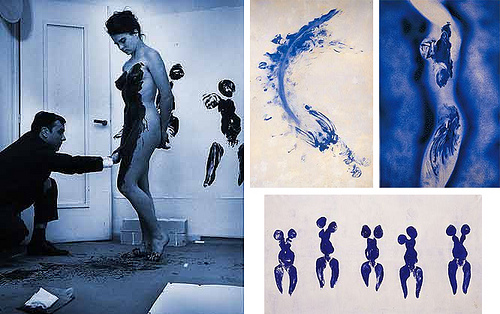
Nel 1957 a Parigi, dopo aver studiato i vari colori e fissativi, sceglie e patenta come suo l’ IKB International Blue Klein. Un punto specifico di Blu (RGB 0; 47; 167) legato ad una resina sintetica a simbolizzare l’unione tra cielo e terra. Sarà il colore predominante di tutte le sue opere successive e vi ricoprirà numerosi oggetti come la Nike di Samotracia, i Prigioni di Michelangelo, spugne, tavoli e molto altro. Anche nelle sue performances Anthropometrie userà il corpo di modelle come pennello che si lanciano su tele giganti creando magnifiche onde o tracce di vita.
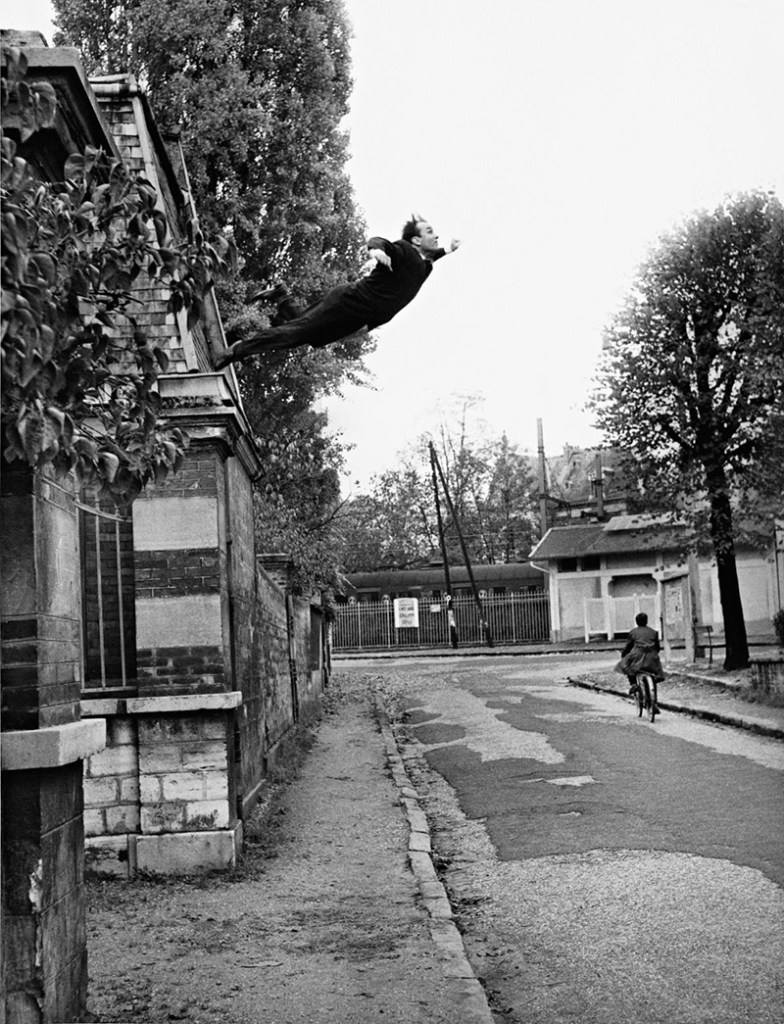
Un altro tema centrale del lavoro di Yves Klein è lo studio dell’immateriale La Vide: il vuoto, l’assenza, gli spazi vuoti di gallerie, ma in realtà satura di “sensibilità pittorica allo stato puro” o contenitori vuoti. Il vuoto influenzato dalla filosofia Zen assorbita in Giappone. Celebre la sua fotografia del 1960 in cui salta da una finestra del primo piano librandosi nel vuoto. Come si scoprirà poi, si tratta di un fotomontaggio di due immagini, sotto c’era un materasso.
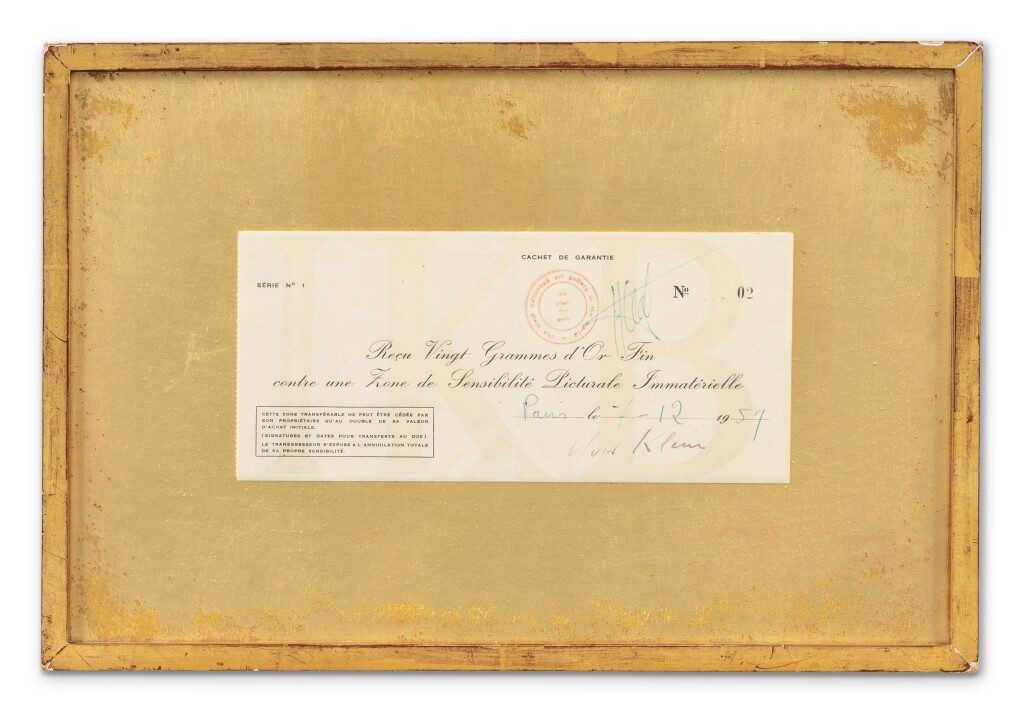
In un’altra sua opera performativa vendette spazi vuoti o immateriale in città in cambio di oro puro. Voleva che gli acquirenti sperimentassero Il Vuoto: l’unico modo di pagare questa esperienza era, secondo lui, solo il materiale più puro, l’oro. Per poi «riequilibrare l’ordine naturale» da lui sbilanciato con la vendita del “vuoto”, Klein gettò l’oro così ottenuto nella Senna. Da qui deriva la ricevuta d’acquisto di uno spazio vuoto che è stata in possesso a Loic Malle ed andata in asta da Sotheby’s il 6 aprile 2022 aggiudicandosi la cifra di €1.000.000.
I monocromi ed il vuoto. In questo si può vedere un legame con gli Achromes o i corpi d’aria di Piero Manzoni (1933-1963), artista molto vicino a Klein. Si conoscono alla Galleria Apollinaire di Milano nel 1957. Entrambi di grandissima profondità intellettuale ed entrambi morti giovanissimi, lavoreranno insieme da Azimut. Lo studio della presenza o della assenza dell’artista, in cui l’arte non è creata dall’artista ma è un totem come sosteneva Jung.
Attraverso soluzioni comuni e sfruttando la forza comunicativa di mezzi simili, Klein e Manzoni, nelle loro brevi ma esplosive carriere hanno portato avanti con forza i loro personali obiettivi artistici: il raggiungimento di una dimensione spirituale e immateriale per Klein, una critica intelligente e ironica alla società contemporanea e al nascente sistema dell’arte per Manzoni.
Bibliografia
* Harrison – Wood, Art in Theory 1900-2000
* Stiles K. and Selz P., Theories and documents of Contemporary art, a sourcebook on artists writings, California Press
* Foster – Krauss – Bois and Buchloch, Arte dal 1900, Zanichelli editore
* Fineberg J., Art since 1940, Strategies of being, H.N. Abrams
* AA. VV., Le Garzantine, Arte, Garzanti
* Vergine L., L’Arte in Trincea. Lessico delle tendenze artistiche 1960-1990. Skira editore
ENG TXT
Born in Nice in 1928 and died in Paris in 1962: Artist, painter, performer, judoka, genius! What can be said about Yves Klein if not about his genius. He started working in Paris in the 1950s after having lived for a long time in Japan where he absorbed its culture and traditions. He grew up artistically attending the Nouveau Réalisme group theorized by Pierre Restany and together with Arman, Christo, Spoerri, Tinguely, Saint-Phalle, what anticipated Pop Art in the USA and Arte Povera in Italy, before and together with Conceptual art.
In 1957 in Paris, after having studied the various colors and fixatives, he chose and patented IKB International Blue Klein like him. A specific point of Blue (RGB 0; 47; 167) linked to a synthetic resin to symbolize the union between heaven and earth. It will be the predominant color of all his subsequent works and will cover numerous objects such as the Nike of Samothrace, Michelangelo’s Prisons, sponges, tables and much more. Also in his performances, Anthropometrie will use the bodies of models as a brush who throw themselves on giant canvases, creating magnificent waves or traces of life.
Another central theme of Yves Klein’s work is the study of the immaterial La Vide: the emptiness, the absence, the empty spaces of galleries, but in reality saturated with “pure pictorial sensitivity” or empty containers. The emptiness influenced by the Zen philosophy absorbed in Japan. He famous his 1960 photograph in which he jumps from a window on the first floor and soars into the void. As it turns out later, it is a photomontage of two images, underneath there was a mattress.
In another of his performative works he sold empty or immaterial spaces in the city in exchange for pure gold. He wanted buyers to experience The Void: the only way to pay for this experience was, in his opinion, only the purest material, gold. In order to then “rebalance the natural order” which he unbalanced with the sale of the “void”, Klein threw the gold thus obtained into the Seine. Hence the purchase receipt of an empty space that was held in Loic Malle and auctioned at Sotheby’s on 6 April 2022, winning the sum of € 1,000,000.
Monochromes and emptiness. In this we can see a link with the Achromes or the air bodies of Piero Manzoni (1933-1963), an artist very close to Klein. They met at the Apollinaire Gallery in Milan in 1957. Both of great intellectual depth and both died very young, they will work together at Azimut. The study of the presence or absence of the artist, in which the art is not created by the artist but is a totem as claimed by Jung.
Through common solutions and exploiting the communicative power of similar means, Klein and Manzoni, in their short but explosive careers, have vigorously pursued their personal artistic goals: the achievement of a spiritual and immaterial dimension for Klein, an intelligent and ironic critique of contemporary society and the nascent art system for Manzoni.
 The Contemporary Art Travellers
Lascia un commento